History
The present-day City Guard Band stands as a memorial to one of the first San Diego bands. In the 1800s, the City of San Diego supported a volunteer community militia as protection against the risks associated with life in the early days of the city. The group was referred to as the City Guard, later included in the California National Guard. One auxiliary unit was the City Guard Band.
The City Guard Band served the needs of the city and as its emissary, around the state and across the nation. The Band gradually disintegrated in the wake of World War I, with many of the musicians moving to other local groups.
In 1980, one hundred years after the initial formation of the City Guard Band, a group of local musicians who were interested in preserving “turn-of-the-century” band music formed the Heritage Band Society, a California not-for-profit corporation. The Society re-established the City Guard Band to keep alive the musical heritage by performing period music (1880 to 1950) in its library of nearly 3,000 compositions for band. The Society’s library also has a comparable number of orchestral works.
Watch – The Heritage Band Society Featured in Ken Kramer’s “About San Diego”
This extensive library includes works written specifically for the Band or the City. In 1887, T.H. Rollinson wrote “The San Diego March” in commemoration of the Band’s national tour the fall of that year. Over the years, additional compositions were contributed to the Band, including “San Diego Exposition March” (1915 Panama-Pacific Exposition), “San Diego, I’m Coming Home to You”, and “San Diego – Finest City” to name a few.
Meet Our Conductors – past and present
Past Conductors – Modern Band
EUGENE DeBAC VACHER –Gene was born in San Diego, raised on a rural El Cajon citrus ranch. His musical life began at age 10 with a mail-order cornet and mail-order lessons. He played professionally in San Diego concert and dance bands as well as eight years with the San Diego Civic Symphony and also taught music in local schools. He entered the U.S. Army and served as a Bandmaster in the U.S., Korea, France and Germany. Gene retired in 1965 as a Chief Warrant Officer having served as Assistant of Chief of Bands for U.S. Army, Europe. Gene was involved in reactivating the San Diego City Guard Band serving as Bandmaster until 2008. During those years he continued teaching and playing with and conducting the mandolin orchestra.
Richard Warnock was born and raised in Pt. Loma, a suburb of San Diego, where he attended Loma Portal Elementary School, Dana Junior High School and Pt. Loma High School. He showed an early interest in music and began playing the clarinet in elementary school. By the time he graduated high school, he had also learned to play oboe, bassoon, trumpet, flute and bagpipes.
While studying at San Diego State, he was a member of the Marching Aztecs, taught the Helix High School Bagpipe Band, and assisted the orchestra teacher at Dana Junior High School. During the 1960’s, he joined the Campbell Chevrolet Pipe Band. Later, he joined the Cameron Highlanders Pipe Band and eventually became Pipe Major of the Band. Playing “the ‘pipes” provided some memorable opportunities for Richard. He played for Prince Charles, aboard the HMS Jupiter and afterward shared drinks with the Prince. He played in a Rod Stewart concert with the Camerons.
After college, his career kept Richard busy, but the music bug bit him again. He volunteered as a music educator at Correia Junior High School and Pt. Loma High School. Volunteering in various capacities became a full-time gig for Richard: bassoon coach with “Band at the Beach” summer music programs, playing and teaching with the Filarmonica Uniao Portuguesa de San Diego and filarmoniado Artesia DES; conductor of the Optimist Youth Band; member and conductor of the City Guard Band; and bassoonist with the New City Sinfonia and San Diego Concert Band.
Jim Trepassso is an accomplished trumpeter, mandolinist, conductor, and music educator. As a retired music educator, he continues to have an impact on local community music programs. He conducts the City Guard Band and the San Diego Mandolin Orchestra. He played in both groups under the direction of Eugene Vacher. He is co-founder of the Peninsula Bands in Concert and is a member the San Diego Concert Band and the Tierra Santa Brass Band. He has been involved with Dell Schroeder’s “Band at the Beach” summer music camp since its inception in 1988. Jim has played in community bands and orchestras from Michigan, Kansas, Hawaii, and San Diego. He was in the U. S. Army Band from 1970 to 1973.
Though he is retired, Jim’s “day job” is instrument repair for San Diego Unified School District. He was featured performer and panelist at the Classical Mandolin Society of America’s 2018 conference.
Music Educator Awards
- David Paul Schulman Award for secondary teachers (2000)
- David Paul Schulman Award for elementary instrumental music (2007)
- Aubrey Penman Retired Music Educator Award (2018)
Colin Weid was the Assistant Conductor and principal trumpet, cornet and flugelhorn. Mr. Wied practiced law for over 50 years and is now pursuing his life-long passion for music. At the age of ten, he became a member of the Bonham Brothers Greater San Diego Boys Band. As a Navy pilot candidate, Colin played in the Cadet Band at the Naval Training Center in Pensacola, FL. In the 1970s and 1980s he played in the San Diego Lawyers Band, a big band. He also currently performs with the El Cajon German Band. He is the founder of the La Jolla Brass, a brass choir at the La Jolla Presbyterian Church.
Past Conductors – Original Band
John Mason Dodge arrived in San Diego in 1870. Dodge first appeared as Bunthorne in Gilbert and Sullivan’s “Patience”. He began presenting minstrel shows and other entertainments around town. A visiting promoter from San Francisco, Robert Kirk, became his first partner.
Dodge and partners took over Horton Hall and the Plaza, where they presented lecturers, musicians, dramas, farces, operettas and minstrel shows .
Like Harold Hill in “The Music Man” Dodge helped found a band for the Knights of St. Pythias, including buying instruments, music and instructional material. E. T. Blackmer took on the task of teaching “the boys” to read music and play their instruments. As a corporal in the City Guard, Dodge formed their band, which used the Knights of St. Pythias members as the core of the City Guard’s new band.
As part of Company B, 7th Regiment of the California National Guard , the City Guard Band gave concerts and marched in parades around San Diego and participated in National Guard encampments across the state. Jack Dodge, wrote, “We had constructed an octagonal shell on the Plaza for the concerts. Our members took great pride in their music and worked hard for their success, and the citizens showed their appreciation for our work in weekly large attendance at our recitals. This stimulated us into greater achievements, and it was not long before the City Guard Band had a statewide reputation.”
Dodge continues, “The good citizens of San Diego took such pride in our accomplishments that they desired that the people of the United States should hear something of the music it gave. … (The) business men of the city agreed to jointly contribute the expenses of a forty day trip of the band through the United States.”
The tour left on September 1, 1887 and began with a concert in San Bernardino. The it continued on to Chicago, Niagara Falls, Boston, Philadelphia, New Your City, Washington, DC, Baltimore, Cincinnati, St. Louis, Kansas City, Denver, and many other places along the way, before returning to San Diego.
From “Jack Dodge His Life and His Times” (Holcomb, William H., Sherman Danby, Los Angeles, CA, 1937)
Isaac Palmer was what they called the drum major of the band; he marched at the head of the band; he didn’t play an instrument, but he marched at the head of the band. He had a big baton. He was a big man, he weighed 315 pounds. He was very tall, over six feet. He made a very impressive sight as he marched at the head of the City Guard Band, because he was a big and very fine looking man.
The City Band gave concerts in the Plaza every week, once a week, and we used to go up there – lots of people went up there and stood around and listened, or they drove. We always drove a horse and buggy when we went there. They had a band stand there, a nice big band stand, where the band played. It was called the City Guard band. I imagine there were fifteen or eighteen men in the band. I don’t know any of their names.
(Mrs. Mattie Crane in an oral interview for the San iego History Center, Oct. 29, 1958)
Peter Frank immigrated from Germany In 1889 and settled in Los Angeles, where he worked as a musician. He moved to San Diego in 1904 and became the Musical Director of the City Guard Band. In 1905 he was Musical Director for the Band and for the Isis Theatre. In 1906, he devoted all his talents to the Isis Theatre. Frank continued to work as a musician and music teacher into the 1920s.
Rudolf Ernest Trognitz (1859 – 1933) was the last conductor of the original San Diego City Guard Band when it folded in 1923. He owned a retail music business in Downtown San Diego, conducted a variety of performing groups, wrote and published music and was an accomplished saxophone player. Trognitz composed pieces for the City Guard Band, including “Ma Java Joe” and “Vocales de la Honda.”
In 1895, Trognitz was asked to teach about 20 aspiring musicians in El Cajon who wanted to start a band. He was successful in building the El Cajon Brass band into a solid performing group that was considered a friendly rival to the more established City Guard Band.
Rudolf Trognitz gathered a group of 54 musicians and give a concert under the name of “The San Diego Symphony Orchestra” in 1902.
The City Guard Band would like to thank the following people and organizations for their assistance in researching the history of the two City Guard Bands and for their support, overall.
Don Harrington, a founding member of the Heritage Band Society who still plays in the Band.
Charles (“Steve”) Claar for donating his time and talents in making videos of the Bands performances.
Ken Kramer and his “About San Diego” television series. Mr. Kramer was happy to support our research and guided us to the segments of his show. The segment about the historical library made a connection with the Pacific Southwest Railway Museum, noted below.
Renato Rodriguez, Archivist with the San Diego History Center in Balboa Park. His enthusiasm for all things San Diego and for research is unbounded.
Bruce Semelsberger and Randy Houk, with the Pacific Southwest Railway Museum for their leads to various items relating to the Band.
The members of the Band, who volunteer their time to rehearse and perform with the Band.
Photos
Links to Video
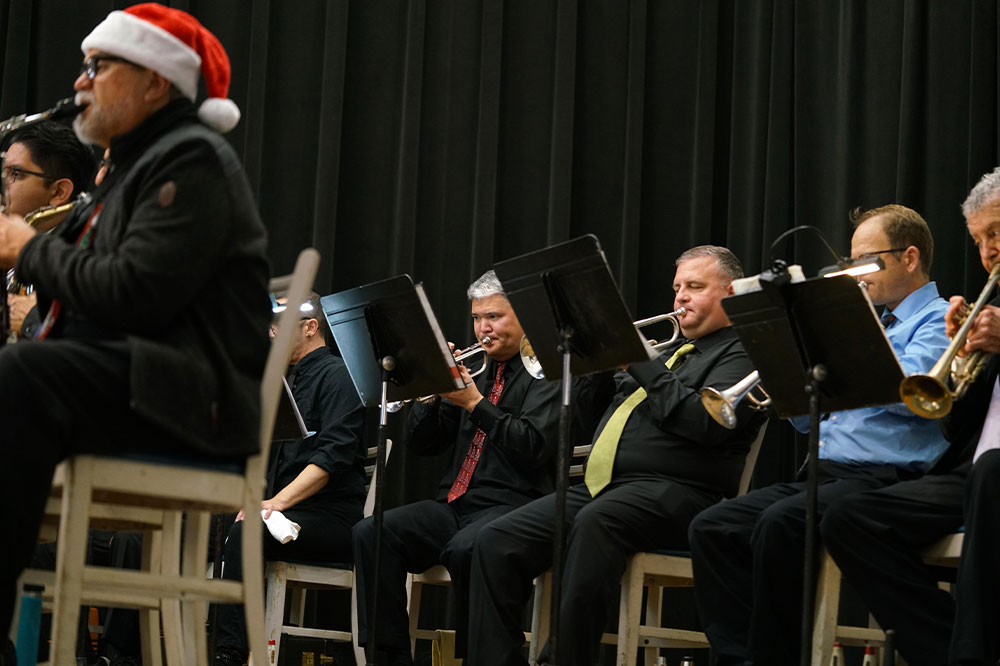
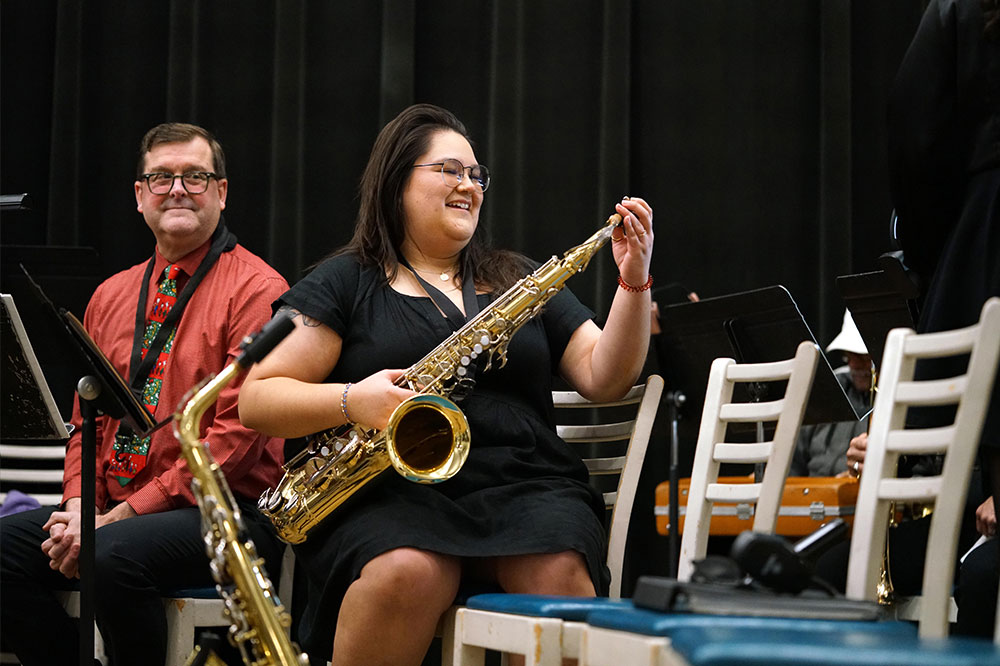
Click below to see video from the Poway Community Band Festival